Table of Content
Also included are webinar recordings describing how to use each of the plan templates and guidance on effectively developing a testing plan using the template. While developed for the COVID-19 pandemic, these resources may be used for other epidemics that stress staffing and testing resources. It may be used to develop a hazard-specific Pandemic Influenza Plan Annex to a facility’s Emergency Operations Plan. This resource provides criteria for evacuation decision-making in nursing homes and is intended to assist administrators and healthcare professionals determine whether to evacuate or shelter-in-place during disasters.

This resource provides suggested emergency operations plan components for the evacuation of long-term care facilities. Provided in tabular form, it lists evacuation categories in one column and suggested responses and best practices in another. It includes general and evacuation provisions, and physical plant, re-entry, and other considerations for widespread evacuation. This webpage provides links to several resources that support planning for long-term care facilities, including an Emergency Operations Plan template; facility profile sheet; plan evaluation checklist; and template for a letter to inform family members of residents of emergency plans.
Incident Command Post Information
This document can help state Long-Term Care Ombudsman programs develop policies and procedures regarding emergency preparedness. While Long-Term Care Ombudsman programs are not first responders, they can play an important role in emergency planning and response. These programs can resolve complaints, protect rights, and promote access to services for residents before, during, and after emergencies and disasters. This webinar discusses evacuation considerations for assisted living facilities, nursing homes, hospitals, and jails given the challenges of mobility and/or security related to the residents of these facilities. Criteria for additional protection of residents through building construction, as well as options for planning, training of staff, practice drills, and notification, are also discussed.

The objectives of this study were to describe the iterative process of emergency planning and preparedness as it relates to post-acute rehabilitation facilities. The study focused on facility staff involved in the evacuation and ongoing care post evacuation, and adults with moderate to severe acquired brain injury receiving residential post-acute rehabilitation and long-term care services. This video was developed to be an educational tool for staff training on emergency preparedness specific to long-term care facilities. This resource page for LTC owners, administrators, and staff and their emergency preparedness partners includes downloadable Word templates to create contingency staffing and testing plans for LTCs.
Featured Resources
An incident is defined as an occurrence, either caused by humans or natural phenomenon, which requires response actions to prevent or minimize loss of life or damage to property and/or the environment. While the ICS may be unfamiliar to the long term care community, it has been in existence since the 1970’s and it is utilized by hospitals as the Hospital Incident Command System . This Situation Manual includes exercise materials from Michigan, where exercise participants were given the tools to implement and evaluate the Long Term Care Facility tabletop exercise. The purpose of this exercise was to provide a forum for LTCs and other organization to participate in a facilitated discussion regarding their roles and responsibilities during shelter-in-place and evacuation emergencies. The second Southeastern Nursing Home Hurricane Summit was held in St. Petersburg Beach, Florida on May 21-22, 2007.
This study was conducted to provide lessons learned from the experience of a small, rural hospice care organization to an actual crisis that required evacuation of the facility. This toolkit was developed to assist with emergency preparedness planning for individuals requiring long-term care. This toolkit includes a discussion of the Incident Command System , HIPAA issues, sample templates, forms, and suggested resources to develop and/or enhance facility emergency preparedness plans. Long-term care includes a range of support services that an individual may need to meet their personal care needs. Long-term care may be provided through home healthcare services, or in facilities, such as nursing homes, assisted living facilities, and continuing care retirement communities.
Plans, Tools, and Templates: Pandemic/Epidemic Influenza Planning
The authors examined nursing home preparedness needs by studying the experiences of nursing homes that sheltered evacuees from Hurricane Katrina. Specific supply, medication, medical records, staffing, and mental health issues were identified for targeted attention during planning. This guidebook is designed to help long-term care facilities evaluate their preparedness for an evacuation. The Disaster Ready Emergency Preparedness Infection Control program provides education and technical assistance for skilled nursing providers throughout the state.

The authors of this report discuss their findings from a study in which they conducted telephone surveys with multiple nursing home administrative directors in Louisiana after Hurricanes Katrina and Gustav. The objective was to ascertain whether nursing home facilities were more prepared to evacuate their nursing home facilities for Hurricane Gustav then they were for Hurricane Katrina.
Plans, Tools, and Templates: Exercises
The Nursing Home Incident Command System should be considered an essential component of a facility’s Emergency Operations Plan that includes events such as pandemics. Proper utilization of NHICS requires that facilities provide its staff with comprehensive training and exercise of the system. NHICS is a resilient incident management model that will guide a facility on managing a situation, either emergent or non-emergent, in a consistent manner in accordance with concepts promoted by the National Incident Management System .

This document provides the findings of focus groups from five states, in which the emphasis of discussions was disaster preparedness in nursing homes. This workbook provides considerations for nursing home facilities that are developing or updating their evacuation plans. It is intended to be used in any emergency requiring either a full or partial evacuation of the nursing home. It provides situations, assumptions, legal authorities, concept of operations, a list of roles and responsibilities, and checklists for various hazards. The Incident Command System, or ICS, is a uniform management model which allows its users to adopt a standard approach for responding to incidents.
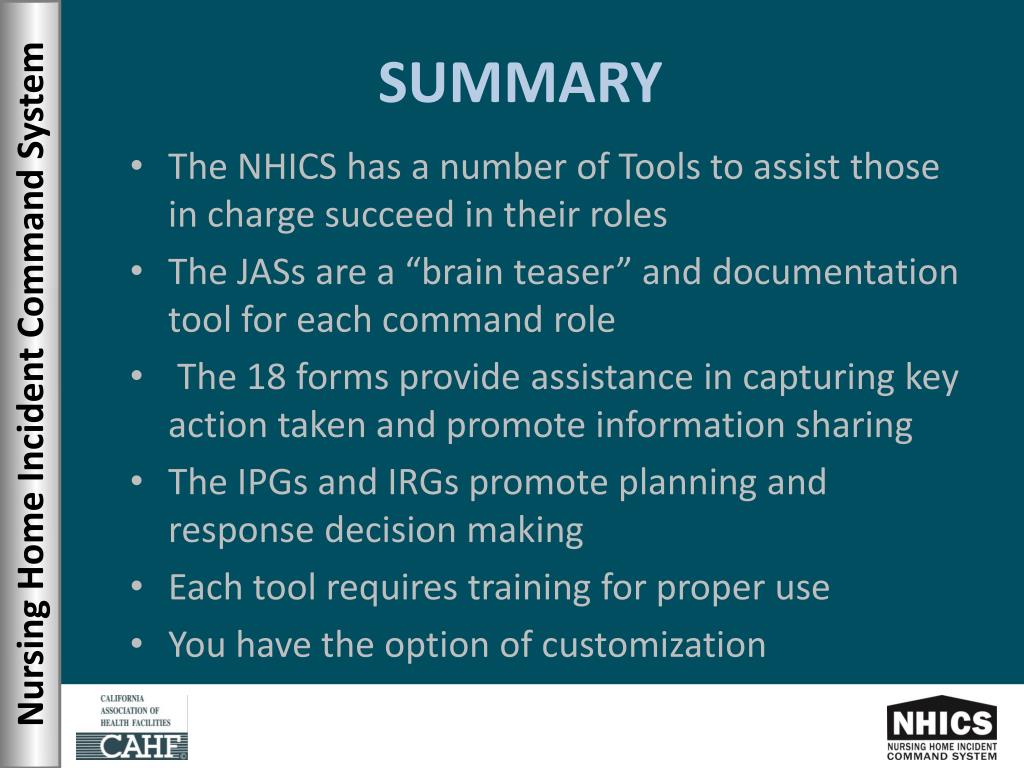
Long-term care facilities pose unique challenges during disasters due to the vulnerability and fragility of their residents. The promulgation of the recent CMS Emergency Preparedness Rule was designed in part to increase the mitigation and preparedness activities of long term care facilities to reduce these risks. This webpage includes information on the nursing home incident command system , which can be used by facilities regardless of size or resident care capabilities, and is intended to assist with their emergency planning and response efforts for all hazards. Links to the NHICS guidebook, forms, response guides, Job Action Sheets , and training are included.
The authors of this report discuss the findings of their study on the evaluation of pre- and post-hurricane mental health service use in Florida nursing homes. Results indicated that although most nursing homes provided some type of mental health service during normal operations, disaster-related mental health services were not routinely provided to residents. The authors also found that receiving facilities were more likely than evacuating facilities to provide treatment to evacuated residents. This document was created to assist nursing homes with the ongoing process of training, exercising, and evaluation to support staff preparedness for emergency response. The Centers for Disease Control and Prevention developed this resource to provide guidance for influenza outbreak management in long-term care facilities. It addresses preventing transmission of influenza viruses and other infectious agents within long-term care facilities, with a multi-faceted approach that includes vaccination, testing, infection control, antiviral treatment, and antiviral chemoprophylaxis.
It provides information about three levels of care, facility type, transport type, and number of residents. This guidance can help disaster planners incorporate ethical considerations into their documents, exercises, and other preparedness activities. A self-service collection of disaster medical, healthcare, and public health preparedness materials, searchable by keywords and functional areas. Originally available in 2010, NHICS was revised again in 2011 by the American Health Care Association Disaster Preparedness Committee to increase its national applicability and relevancy to long-term care health facilities.
The authors of this article describe the influenza pandemic planning process that was conducted by a geriatric facility in Toronto, Canada. The facility developed a pandemic plan in order to ensure preparedness for staff, clients, and families. This document provides guidance to long-term care facilities on developing or modifying emergency preparedness communications procedures. These slides are from a webinar that discussed the results of a study conducted by the Emory University Preparedness and Emergency Response Research Center . The study examined disaster preparedness in nursing homes and home health agencies, which have typically not been included in disaster planning efforts. This program has been produced by the Center for HICS Education and Training with funding from the California Long Term Care Association.
Elevating the Post-Acute and Long Term Care Profession
Individuals needing long-term care may include the elderly, those with chronic health conditions, and individuals requiring short-term rehabilitation. The authors asked nursing homes in North Carolina and South Carolina to measure their preparedness using the Centers for Medicare and Medicaid Services emergency preparedness checklist. In October 2007, a series of wildfires burned over 500,000 acres in Southern California causing 14 nursing homes to evacuate more than 1,200 residents. In response to this event, nursing home administrators and officials from various healthcare and emergency management agencies in San Diego County collaborated to form a model for nursing home emergency preparedness. The authors of this report describe the model, known as the area coordinator system, and discuss its strengths, limitations, and how it could be replicated in other areas of the country.
Individual providers will need to exercise their independent discretion in how to apply this information and technical assistance to the unique operation of each facility. For that reason, a facility’s use of its professional judgment and due diligence in utilizing the program for infection control and risk management practices is solely within the facility’s control for which it is entirely responsible. The Centers for Disease Control and Prevention developed this checklist to help long-term care and other residential facilities assess and improve their preparedness for responding to pandemic influenza. Long-term care and other residential facilities can use this checklist to self-assess the strengths and weaknesses of current planning efforts.




No comments:
Post a Comment